
Getting a certification in art and design has always been one of my lifelong goals. One of the milestones I reached in 2025 was enrolling in a master’s-by-coursework programme at an institution near where I live.
With my main business in a downturn, I decided not to pour all my energy into fixing it. I took a different route instead. I chose to free up my mind and return to art studies. The institution happened to offer a one-year intensive coursework programme, which was exactly what I had been looking for. Part of me also wanted to test something: in an age where AI can draft and analyse in minutes, does going back to school still hold real value?
The Institution
The institution isn’t a top school. It isn’t even listed in the QS rankings. In my view it sits in the mid-tier. Still, with the boom in demand for foreign postgraduate study, it has been expanding in recent years, adding more programmes that range from master’s degrees to PhDs. I do have some doubts about the research quality here, but that’s another story.
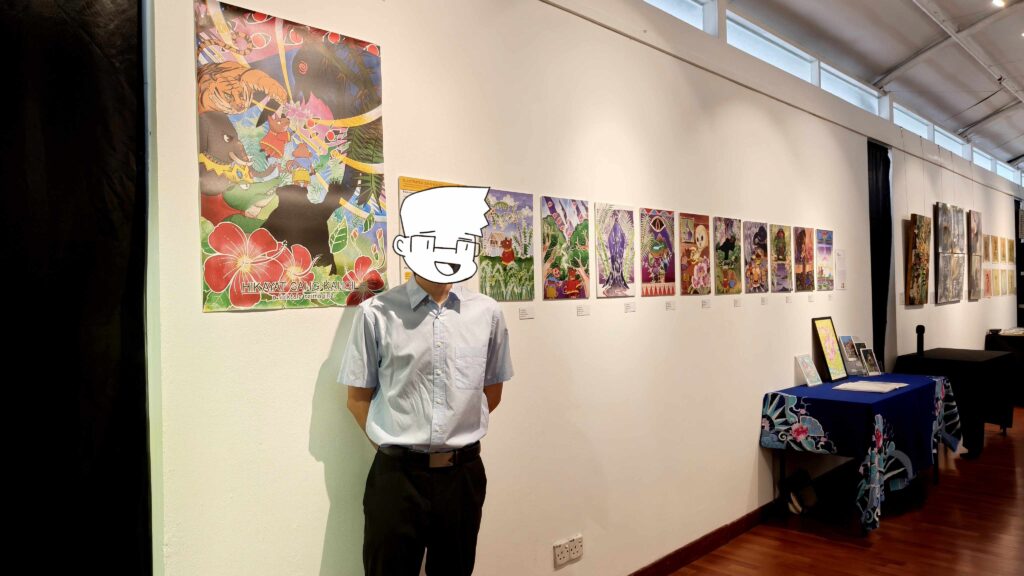
Its biggest advantage is that it is a stone’s throw from my place. It is also the only proper higher education institution offering art programmes in the area. They recently acquired a new building with great potential. The library is small but well-stocked with a good collection of books. One thing I like is that the faculty of art has its own gallery, an important platform for in-house students and a potential spot for local creatives.
The Course
The programme is coursework based. You mostly attend classes and finish hands-on projects. Courses cover research methodology, critical practice and production culture, cultural studies, digital art and technology, installation, type, and a master’s project. Most classes stay on the surface. Unless you are truly interested in a topic and dig in yourself, don’t expect to learn much from the class alone. The lecturers are friendly and can be strict, and most come from an academic background. If you are after practical skills and up-to-date tech, there is a gap. The course works more like a sharing session, so as a graduate student you need to find the knowledge yourself.
The programme runs across three semesters: one long semester of four months, and two short semesters of three months and 1.5 months. From the second semester on, we choose our own topic and build a master’s project that carries through to the end.
My Verdict
This is the first batch of the programme, so everything feels new and, honestly, messy. The guidance and course structure could be better streamlined.
One downside is how wide the class demographic is. There are six of us, aged from early 20s to 80s. Our backgrounds vary just as much: 3D lecturers, professionals from construction, and fine artists. On top of that, the course is taught in English, yet half the class comes from a China cohort with limited English. Without language support in an English-taught course, this creates a real gap. Some concepts land easily for a few of us while staying foreign to others, and it makes delivering assignments hard for the lecturers.
Because it is full-time, this past year was a challenge. I juggled a day job, daily chores, and my studies. Still, I pushed through.
This programme is ideal for anyone who already has a research topic in mind and wants to go deeper into academic study. If you just want to pick up a practical skill or two, you would honestly be better off subscribing to online courses. And this is where the AI question comes back. For raw skills and quick output, the tools are already faster than any classroom. What a programme like this offers is something else: structure, and the push to think critically.
Fortunately, I had a focus before signing up: to explore and develop an artistic language tied to local cultural roots. On that front, the programme has been a real help. It gave me the structure to turn what I already knew into a proper research framework, from applying critical theory, to using solid qualitative and quantitative methods, to refining how I present my work.
Conclusion
With Generative AI moving so fast, I sometimes ask myself whether a postgraduate degree is even necessary anymore. Writing a dissertation and running data analysis has become far quicker with AI than in the pre-LLM era. Tasks that once took days can now be done in minutes.
But I believe that the faster AI advances, the more we need to stay critical and keep learning. AI is undeniably good at processing information, spotting patterns, and putting pieces together. Yet true knowledge still needs real human input, cultural context, and lived experience to create genuine innovation. AI can synthesize the past, but it still takes a human creator to define the future of art and design.
Leave a Reply